


The new Consumer Credit Directive is coming — and it changes how loans may be granted and assessed.
From November 20, 2026, Germany’s new Consumer Credit Directive CCD2 (Consumer Credit Directive 2) comes into effect, establishing a legal framework that fundamentally restructures lending across Europe. For banks and credit intermediaries, this is not a warning signal — it’s a starting point: those who consistently implement the directive’s requirements gain legal certainty, trust, and competitive advantage.
The core of the directive is clear: loans may only be granted if the assessment shows that the consumer is highly likely to meet their obligations — including small loans. This requirement sounds straightforward — but in practice it means that many existing processes need to be reviewed. Those who still rely exclusively on backward-looking credit scores may no longer be providing a sufficiently robust basis for decision-making.
What changes with CCD2? The key new requirements
The directive replaces the previous Consumer Credit Directive from 2008 and responds to today’s digital reality.
The key changes at a glance:
- Extended scope: CCD2 now covers small loans from €200 for the first time, interest- and fee-free loans, short-term loans of up to three months, as well as Buy Now Pay Later (BNPL) models and overdraft facilities.
- Clear communication: Lenders must ensure that all credit terms are communicated transparently and comprehensibly before the contract is concluded.
- Stricter creditworthiness assessment: Loans may only be granted if the assessment shows that the consumer is highly likely to meet their obligations — proportionate to the type of loan, documented, and audit-proof.
- Transparency in credit decisions: Consumers have the right to an explanation when an algorithm evaluates or rejects their application. Providers must disclose which data is used and how it influences the decision.
- Ban on social media data: Data from social networks may not be used for creditworthiness assessments.
- Digital contract process: Text form instead of written form enables fully digital contract conclusions without a qualified electronic signature.
- Conduct obligations and remuneration rules: The remuneration of credit intermediaries may no longer depend on the loan volume or the number of approved applications.
- Debt counseling and forbearance: In cases of payment difficulties, lenders must actively review relief measures — deferral, restructuring, interest reduction — and refer borrowers to counseling services.
What changes for lenders and borrowers?
For banks and credit intermediaries, CCD2 is first and foremost an operational challenge: product portfolios must be reviewed, IT systems adapted, and contract processes digitized. The creditworthiness assessment is a particular focus — it must be documented, explainable, and proportionate. Those using automated procedures must make them auditable. Those who have relied on simple credit score queries will need a validatable and standardized data foundation.
For borrowers, CCD2 means more protection and greater fairness: they receive more transparent information before signing a contract, a limited right of withdrawal, and — for the first time — a reason for rejection along with a referral to debt counseling. The directive strengthens trust in the credit market and protects against over-indebtedness — especially at a time when BNPL and digital small loans are part of everyday life.
Why traditional scoring models alone are no longer sufficient
Traditional scoring models such as Schufa credit checks are a proven tool — but one that looks into the past. Score-based reports condense historical credit data into a single metric. This is useful, but often provides an incomplete picture of a person’s current financial situation.
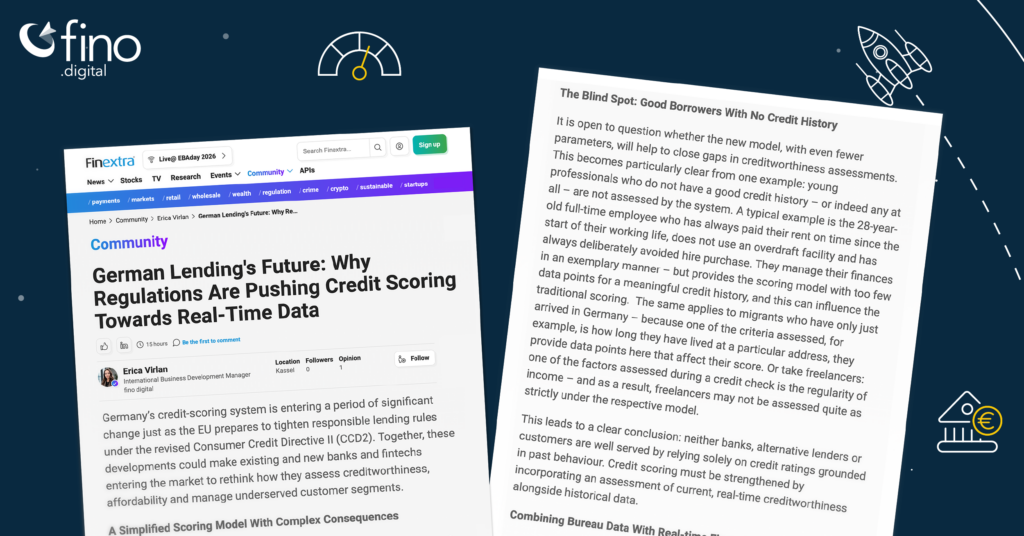
A typical example: A 28-year-old full-time employee who has paid her rent on time for years, never uses her overdraft, and has deliberately avoided installment purchases — managing her finances exemplarily. Yet this is exactly what can work against her in traditional scoring: those who have built up little credit history provide too few data points for the scoring model. Transaction data analysis, on the other hand, looks at the account and immediately recognizes: stable income, low expenditure surplus, no payment disruptions whatsoever. CCD2 requires lenders to include relevant, up-to-date information — income, expenses, and financial obligations — in their assessments. Traditional scoring alone will frequently no longer meet this standard.
AI-based account analysis: The missing dimension in creditworthiness assessment
This is exactly where fino digital’s account analysis comes in as an Open Finance solution. With the borrower’s explicit consent, it analyzes actual account transactions — automated, precise, and in real time. What becomes visible complements the traditional score with crucial information:
- Regular and stable income streams, such as salary, rental income, etc.
- Ongoing financial obligations and contracts: existing loans and credits, leasing agreements, insurance contracts, rent, subscriptions
- Available monthly surplus after all expenses and obligations
- Early indicators of financial stress: returned direct debits, account overdrafts, irregular spending patterns
- AI-based forecast of future payment capacity based on real behavioral data
"Those who still rely exclusively on backward-looking scores today are assessing creditworthiness with a tool from yesterday. Digital account analysis makes it possible to evaluate people based on their actual current financial situation — transparent, data-driven, and fair. This is not only what CCD2 demands; it is what responsible lending is all about."
Aleksandar Jeremic, CEO fino digital
Benefits for lenders: precision, compliance, and competitive advantage
For banks and credit intermediaries, the use of automated account analysis in creditworthiness assessment offers concrete benefits:
- CCD2 compliance by design: Account-based assessment provides a traceable, documented, and explainable decision-making foundation — exactly what the directive requires.
- Better risk prediction and reduced default rates: Those who know a customer’s current situation make more precise default forecasts and can manage their portfolio more effectively.
- Faster decisions: AI-based account analysis replaces manual document review, minimizes errors, and significantly accelerates the lending process for customers.
- Unlocking new target groups: First-time jobholders, self-employed individuals, or newcomers without an extensive credit history can be assessed fairly based on current account data.
- Competitive differentiation: Those who adopt modern scoring infrastructure early build a structural advantage — in quality, speed, and compliance.
Benefits for borrowers: fairness, speed, and self-determination
There are also benefits on the customer side:
- Fairer assessment: Those who are solvent today are assessed as such — regardless of their past credit history.
- Faster decisions: No long waiting times — the process runs digitally, transparently, and efficiently, with the option to supplement it with documents if needed.
- Data sovereignty: Borrowers share their account data only with explicit consent and retain control over their own data.
- Protection against over-indebtedness: Because financial resilience is assessed more precisely, the risk of receiving a loan that cannot be serviced in the long term decreases — reducing the danger of falling into over-indebtedness.
Conclusion: CCD2 as the Starting Point for Better Credit Decisions
CCD2 is not just a compliance exercise. It’s a call to fundamentally rethink lending — more data-driven, fairer, and more resilient. Traditional scoring models remain an important building block, but must be complemented by intelligent, digital analysis of account data to meet the demands of responsible and transparent credit decisions.
At fino digital, we support banks and credit intermediaries with exactly that: Open Finance solutions based on verified real-time data, fully explainable, and seamlessly integrable into existing lending workflows. The technology is ready. The regulatory framework is in place. Now is the right time to act.
Would you like to learn more about how fino digital can help you implement CCD2 requirements efficiently and in a compliance-secure way with digital scoring solutions?
We are happy to advise you on how creditworthiness assessments work in practice with innovative data analytics solutions – and what this means specifically for your loan process.